What shocks do
Their primary function and location
All vehicles on the road have some form of shock absorber. They are located on the
front and rear wheels or axels of the vehicle and are connected to the vehicle suspension
system – tyres, springs, chassis and their linking components.
Their primary function is to keep the vehicle’s wheels in contact with the road.
Secondary functions are to ensure more accurate control and steering of the vehicle
and to correct phasing (the movement of the suspension).
Most newer cars have struts instead of shocks. Struts are compact and allow for lighter
vehicles.
They not only control the up and down movement of the tyre, but contribute to the
steering’s
pivotal rotation.
How they work
Shock absorbers slow down and reduce vibration by turning the kinetic energy of the
suspension movement into heat energy, and then dispersing this heat energy through
hydraulic fluid.
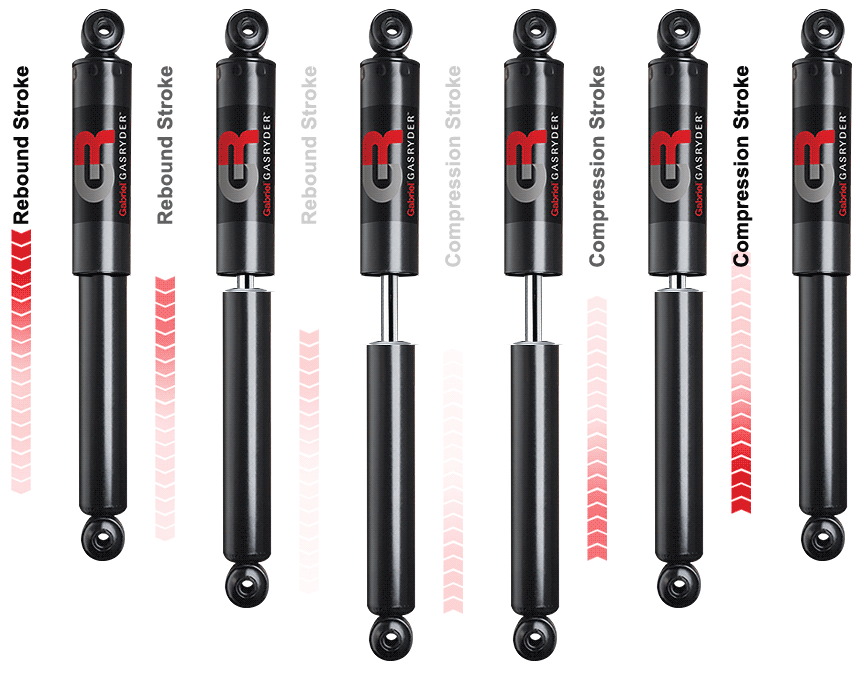
Shock absorbers work in two cycles: the compression cycle and the extension cycle.
When the wheel travels upwards causing the spring and shock absorber to shorten,
the shock absorber is said to be in
COMPRESSION STROKE.
When the road wheel starts to move back down, the shock absorber is lengthened and
said to be in REBOUND OR EXTENSION.
A typical car or light truck will have more resistance during its extension cycle
than its compression cycle.
The faster the suspension moves, the more resistance the shock absorber provides.
This enables shocks
to adjust to road conditions and to control all of the unwanted motions that can
occur in a moving vehicle, including bounce, sway, brake dive and acceleration squat.
Are all shocks the same?
“Shock absorber” is a common term used for all shocks but there are various types:
- Standard telescopic shock absorbers
- McPherson struts
- Spring seat shock absorbers
- Cartridges
Replacing your shocks at regular intervals will help keep your car performing like
new, but choosing the right shocks can make a big difference. Today the design and
manufacture of shock absorbers is a high technology, precision industry.