

Gaslifts
Gabriel® Gaslift®
The Gabriel® Gaslift® series is designed to be a hassle free and customisable solution
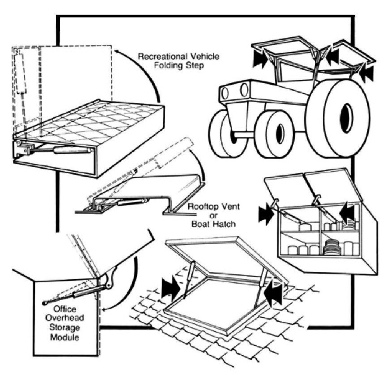
to assist in many various applications from, bonnet and boot applications, opening,
holding open and closing doors to canopies, sun beds and window solution.
The Gabriel® Gaslift® range is also available in extensive automotive and industrial applications.
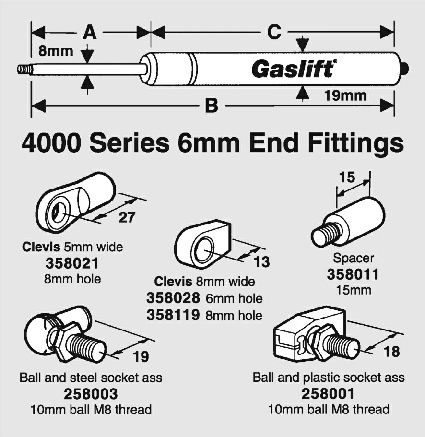
The range is supported through a variety of connection end fittings. Further, there is a
national gas filling solution to fill units to a specific pressure to meet the required weight,
angle and solution.
All of the range is covered by the Gabriel warranty and delivers up to its historical
South African pedigree and provides for total peace of mind.



Product Feature Product Benefits
Product Feature
Ø16 and Ø19 Bore working cylinder
Designed to be used to a pressure of up to 1000N
(rod size applicable)
Uses specific oil infused with nitrogen which is designed
to work in South African and African climates
Single lip rod seals
Sintered metal rod guides
Product Benefits
A hassle-
The industrial range can be customised for particular applications
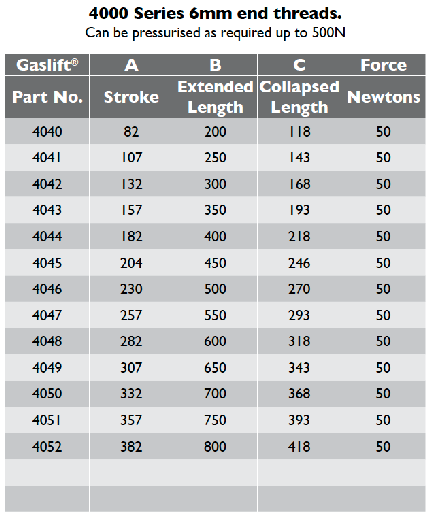
• 4000 Series
can be pressurised to 500N
• 4100 Series can be pressurised to 1000N
Plastic or metal end fittings to suit specific applications
and cost options
Universal canopy replacements
Manufactured locally to the highest quality standards using premium
quality components
The Gaslift® spring consists of a cylinder, piston and rod assembly able to extend and contract telescopically. The cylinder is filled with nitrogen
gas at a very high pressure. It is this gas pressure which creates the lifting ability of the Gaslift® and the force exerted is proportional to
the gas pressure.
A measured quantity of oil inside the Gaslift® lubricates the piston assembly and provides damping at the end of the extension movement.
The damping imparts a more gentle action to the object being moved. Therefore, the Gaslift® should always be mounted with the rod in
a downward position, when the door is fully opened.

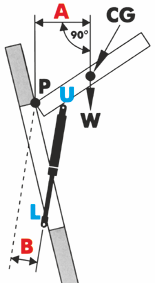
Calculating the force (F1)
Required to hold the lid in the Open position Refer to the diagram:
F1 – Force exerted by Gaslift® in Fully Extended Condition
U – Upper Mounting Point
L
– Lower Mounting Point
P – Pivot Point
CG – Centre of Gravity
A – Horizontal Distance
from CG to Pivot Point P
B – P erpendicular Distance from axis U-
W – Weight/Mass of lid
If the position of the CG of the lid is not known, then a spring balance or similar can be used to measure the force required to hold the door open.
If the force is measured at the upper mounting point U this force plus 10 – 15% safety factor is the F1 required. If the force is measured at any
other point, use the perpendicular distance from the pivot point P to the attachment point of the spring balance as A and the spring balance
reading as W in the formula.

Diagram of typical application
(*Refer formula to calculate)
Note:
By changing the Gaslift® axis U – L the lid can be made to open automatically once the catch is released, or stay closed so that no catch is required. The calculated force is only enough to balance the mass – add more to keep the flap
firmly in place.
Work to low side of the calculated pressure at first because additional gas can be added,
but pressure cannot be reduced.







 FIND A STOCKIST
MAPS
PHOTOS
VIDEOS
PRODUCT CATALOGUE
FACEBOOK
TWITTER
D6
FIND A STOCKIST
MAPS
PHOTOS
VIDEOS
PRODUCT CATALOGUE
FACEBOOK
TWITTER
D6



| Company Profile |
| Gabriel Wings |
| What Shocks Do |
| FAQ and Knowledge Base |
| Get Shocks |
| Risks of Worn Shocks |
| Pre-Trip Checklist |
| Test Your Shocks |
| Innovation and Leadership |
| Our Advantage |
| Product Applications |
| Find a Dealer |
| Product Range |
| Suspension Tester |
| Gas Filling Machine |
| Gaslifts |
| I am Interested |